Video editor: why someone else lands the clients you want
Clients don’t choose on editing quality alone: they choose the editor who helps them picture their project. Show a close example, explain your choices and propose a precise deliverable. A method, eight message templates and examples by business.
MoBenFreelance video creator
Contents
- Why can a less technical editor have more clients?
- An example: two editors and the same restaurant
- How should you present a project in your portfolio?
- How do you reach out to a client without sending your whole portfolio?
- What should you send a client? Eight templates to adapt
- How do you adapt the first message to the client’s business?
- Doing good work and making it understood: two different skills
- Frequently asked questions
If an editor with less technique than you lands more clients, it is often because clients don’t choose on editing quality alone. They choose the person who proves they understood the need and helps them picture the project. Show an example close to the request, explain your choices and propose a precise deliverable with a timeline.
Have you ever seen someone doing the same work as you and thought: “I’m better than him… but he’s the one with the clients”? You may be comparing on one thing while the client chooses on another.
Why can a less technical editor have more clients?
You look at technique, effects, the difference in quality. The client hasn’t tried you yet. Before working with you, they don’t know how the project will go, or whether the result will match what they have in mind.
The level you are sure of still needs proof for them. And the proof they are looking for is not always the one you show.
An example: two editors and the same restaurant
Picture a restaurant owner who wants people to hear about a new promotion. The first editor sends a showreel full of nice effects and writes: “I make professional videos.” The second shows an example close to what the owner needs, explains how to present the promotion, what will be delivered and when.
The first proved he can edit. The second proved something more: that he understood what the restaurant needs. He isn’t necessarily the better editor, but he let the owner picture the work he will receive and how the project will run.
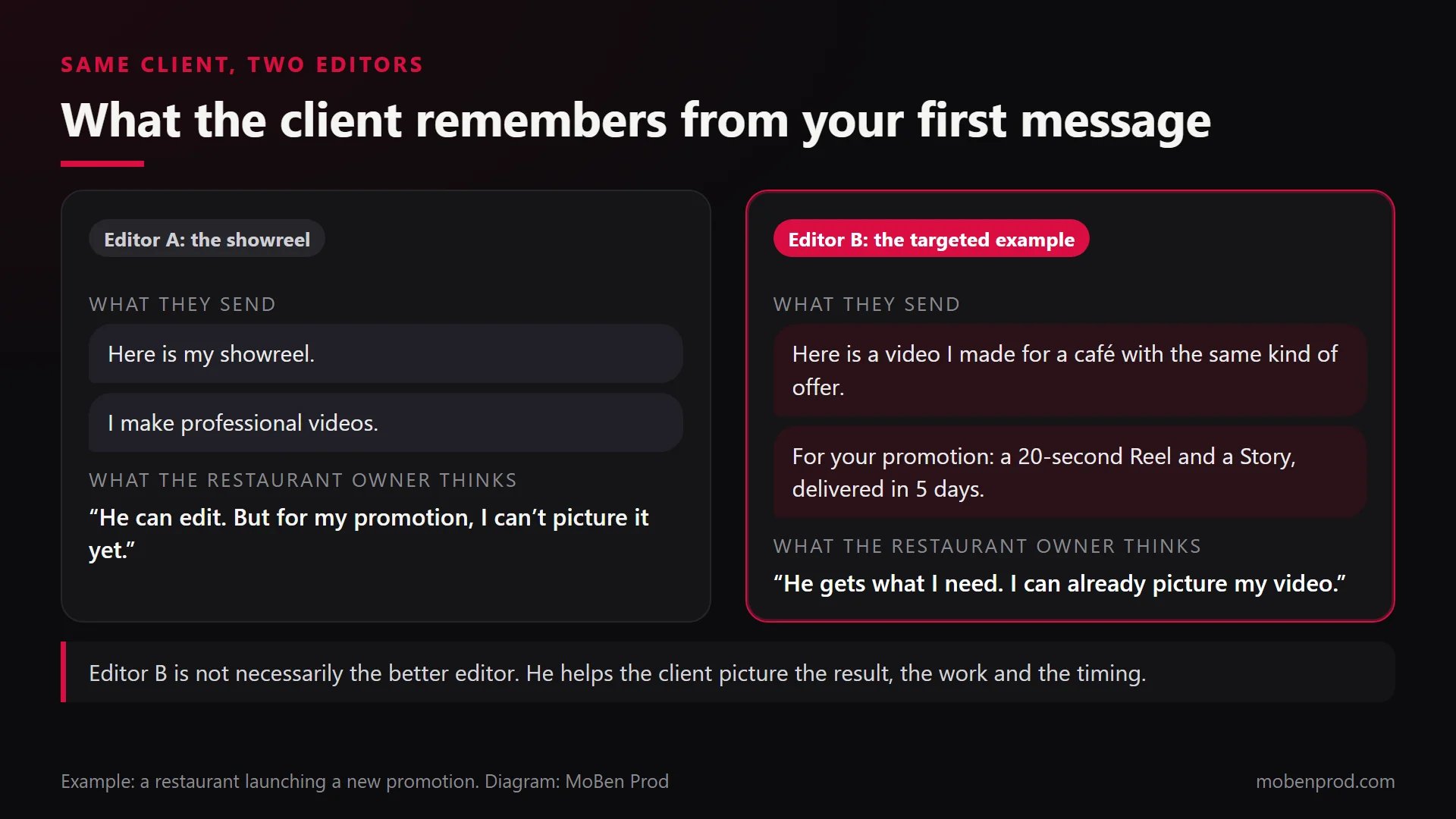
This doesn’t mean quality doesn’t matter. It means you have to show you are aware of the need, and the client has to understand why you, and not someone else, are the right person.
How should you present a project in your portfolio?
When you share a project, don’t stop at “Look at what I do”. Explain four things:
- The request: what the client wanted, for whom and for which platform.
- The problem: what was in the way, what had to change.
- Your choices: why this format, length, pace and music, and not another option.
- The deliverable: files, formats and timing. Results in numbers only if they were really measured.
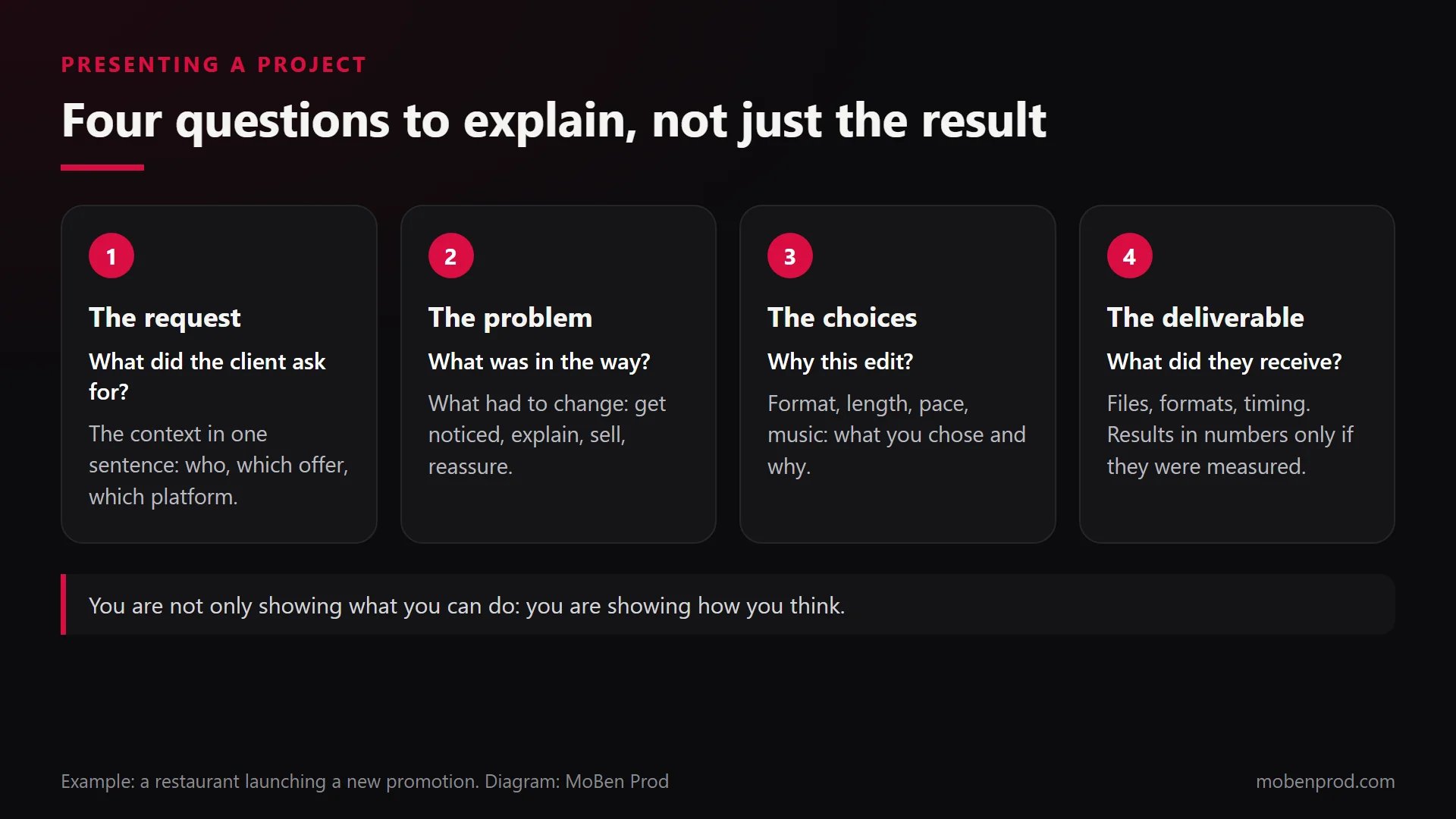
That way you don’t only show the result: you show how you think. And if you are starting out without client work, the same method works with a personal project edited from free footage, as long as you say clearly that it is one.
How do you reach out to a client without sending your whole portfolio?
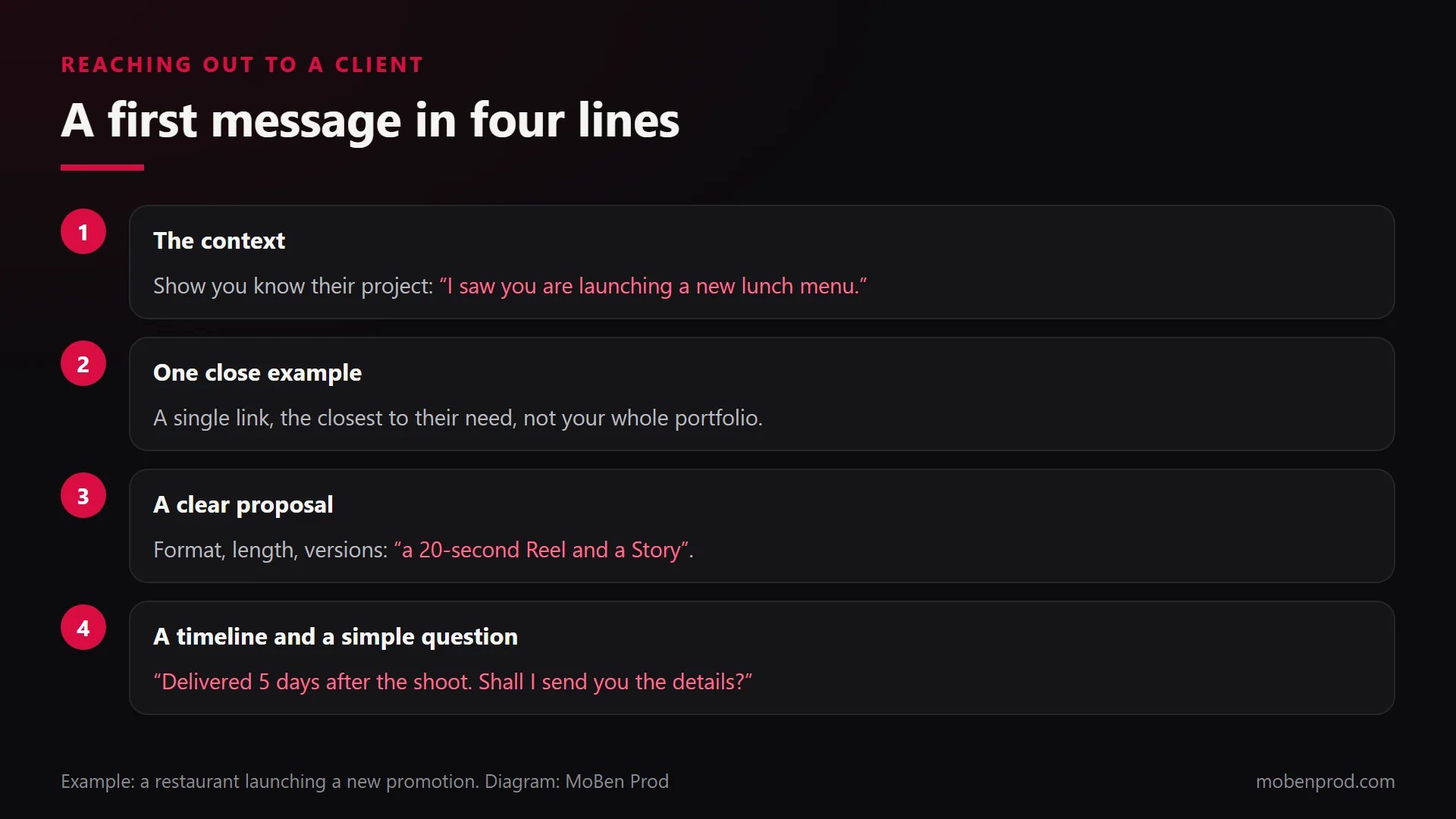
When you talk to a client, don’t send your entire portfolio and leave them to dig through it. Pick an example close to what they want and link it to a clear proposal that can help their project.
That way you are not just saying “Trust me”. You are showing them what that trust can rest on.
What should you send a client? Eight templates to adapt
Replace what is in brackets with your real situation. Keep one link per message, and never invent a result you haven’t measured. The templates follow the order of a real conversation, from the first contact to after delivery.
1. The first message to a potential client
“Hi [first name], I saw you are launching [a new lunch menu]. I edited a video for [a café] with a similar goal: [link]. For your promotion, I suggest [a 20-second Reel and a Story], with the dish, the price and the date clearly visible. Delivered [5 days] after the shoot. Shall I send you the details?”
2. When the client writes “Send me something you’ve made”
“Sure. The project closest to yours is this one: [link]. The client wanted [to announce an offer in 20 seconds]. I [showed the dish and the price in the first three seconds] so that [the offer was clear even with the sound off]. For you, I would go with [the same format]: I can prepare a proposal for you today.”
3. The follow-up, a few days later
“Hi [first name], I’m getting back to you about [your lunch promotion]. If it’s still on, I can send you a proposal with the format, timeline and price. If not, no problem, I’m available for a future project.”
4. Presenting a project in your portfolio
“Request: [a Reel announcing a new menu]. Problem: [the offer wasn’t clear with the sound off]. Choices: [dish and price in the first three seconds, subtitles, 20 seconds in total]. Delivered: [a Reel, a Story and a square version, in 5 days].”
5. When the client asks “How much is it?”
“For [a 20-second Reel and a Story], it’s [price]. That includes [editing, subtitles, licensed music and two rounds of revisions]. Delivered [5 days] after I receive the footage. If you also want [a square version for Facebook], it’s [price] extra. Shall I prepare the quote?”
Always give the price together with what it includes. A number on its own gets compared. A number with a clear deliverable gets understood.
6. When the client replies “That’s too expensive”
“I understand. Rather than lowering the price of the same work, I can offer a simpler version: [a single 15-second Reel, no Story], for [price]. You keep [the essentials: the dish, the price and the date visible from the start]. Would that work for you?”
You change what the offer contains, not the value of your work. The client keeps the choice, and you don’t get into the habit of underpricing.
7. After delivery: asking for a review
“Thanks again for trusting me with [the lunch promotion video]. If you are happy with the result, would you write two or three sentences about how the project went? I would add them next to the video in my portfolio, with your permission.”
That review becomes the proof the next client is looking for: what working with you is like, told by someone other than you.
8. When the client chose another editor
“Thanks for letting me know, and all the best with [your promotion]. If you ever need [a short version for Stories or another project], I’d be glad to talk about it.”
A short message with no hard feelings keeps the door open. The client may come back for the next project, or if the first choice didn’t go as planned.
How do you adapt the first message to the client’s business?
Template 1 works in every sector. What changes is the context you mention and the proposal. Here are message openings ready to complete:
- Restaurant or café: “I saw you are launching [a new menu]. I suggest a 20-second Reel with the dish, the price and the date visible from the first seconds.”
- Real estate agent: “I saw your listing for [the flat on X street]. I suggest a 45-second vertical video tour, room by room, with the floor area and the price on screen.”
- Coach or trainer: “I saw you are opening [a new training session]. I suggest a 60-second subtitled presentation video where you explain who it is for and what people will learn.”
- Online shop: “I saw [your new product] on your site. I suggest three short videos: the product in hand, how it is used, and the answer to the question you get asked most.”
- Gym: “I saw you are launching [a new class]. I suggest a 20-second Reel filmed during a real session, with the schedule and the trial price at the end.”
- Craftsman or building company: “I saw your photos of the [kitchen] job. I suggest a 30-second before/after video using your photos and a few shots filmed on site.”
- Podcast or YouTube channel: “I listened to [your latest episode]. I suggest pulling three subtitled vertical clips of 30 to 60 seconds from each episode.”
- Wedding or event: “I saw you are organising [your event on …]. I suggest a 60-second short film to share the next day, on top of the full film.”
Then keep the rest of template 1: a close example, the timeline and a simple question.
The mistakes that lose the client from the first message
- Sending your whole portfolio and letting them search.
- Talking about yourself, your software and your gear rather than their project.
- Staying vague: “I make quality videos” instead of a format, a length and a timeline.
- Writing a long message the client won’t read to the end.
- Sending the same message to everyone without mentioning their project.
- Announcing views or sales you have never measured.
Doing good work and making it understood: two different skills
The person you are watching may have less technique than you… but they got ahead on this side. Producing good work is one skill. Understanding the client, explaining your value and giving them reasons to rely on you is another.
If you only develop the first, you have learned the craft. You still have to learn how to make a living from it.
Frequently asked questions
Do you still need a showreel?
Yes, it is still useful as a general showcase on your website or profile. But in front of a specific client, an example close to their request, with a proposal, speaks to them much faster.
What if I have no example close to their project?
Show the closest one you have and explain what will be different for them. You can also prepare a short personal project on that kind of subject, presented honestly as a personal project.
How many examples should a first message include?
One, two at most. The more you send, the more you leave the client to sort through them for you, and the less they see what you understood about their need.
What does a client want to know before choosing an editor?
What they will receive, when, and how the project will run. I wrote about the client’s side of the question in how to choose a freelance video editor and prepare the brief: it is a good way to understand what they expect from you.
And if you are on the brand side, looking for an editor who starts from your need, here is how I handle editing and post-production. Tell me about your project.
Go further